
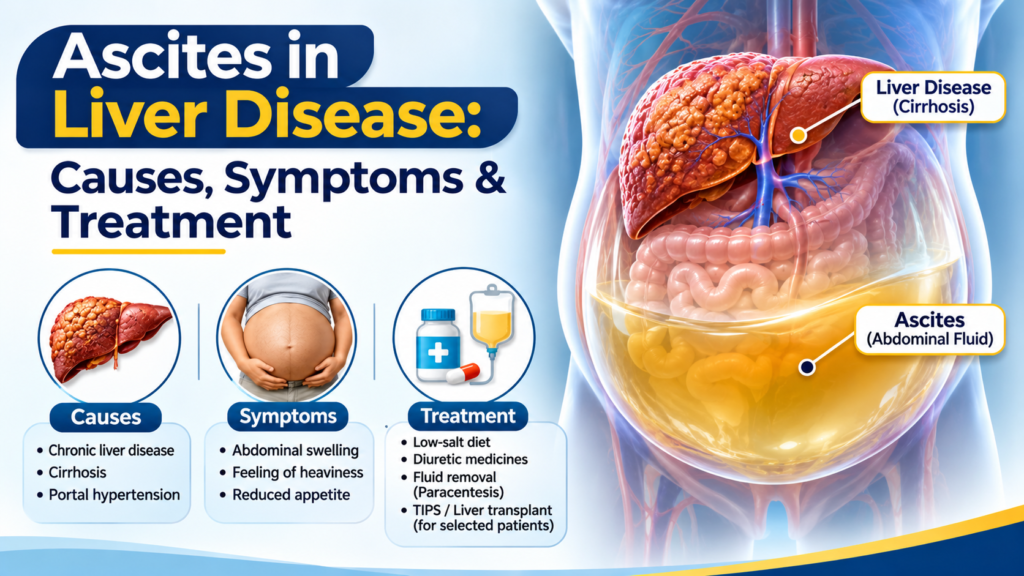
Ascites in Liver Disease: Why Fluid Builds Up in the Abdomen and How It Is Treated
Ascites is the accumulation of excess fluid inside the abdominal cavity. It is a common complication of advanced liver disease, particularly cirrhosis. The condition can cause the abdomen to become swollen or enlarged and may lead to discomfort, reduced appetite and difficulty breathing.
In people with liver disease, ascites can develop when changes in blood flow through the liver and alterations in fluid regulation cause fluid to collect inside the abdomen. It may develop gradually or appear more suddenly, depending on the underlying condition.
Understanding the causes, symptoms, diagnostic tests and available treatment options can help patients recognise when medical attention is needed.
What Is Ascites in Liver Disease?
Ascites refers to an abnormal collection of fluid in the peritoneal cavity, the space between the abdominal organs and the abdominal wall.
A small amount of fluid is normally present in this space to allow the organs to move smoothly. However, certain medical conditions can cause excessive fluid accumulation.
Liver cirrhosis is one of the most common causes of ascites. As healthy liver tissue becomes replaced by scar tissue, blood encounters increased resistance while passing through the liver. This can increase pressure in the portal venous system, a condition known as portal hypertension.
At the same time, advanced liver disease can affect the body’s ability to regulate sodium and water. These changes contribute to fluid accumulation in the abdomen.
Ascites may be an indication that chronic liver disease has progressed and requires careful medical evaluation.
What Causes Ascites in Liver Disease?
Ascites can develop due to several changes associated with liver damage and portal hypertension.
1. Portal Hypertension
Portal hypertension occurs when pressure increases in the portal vein, which carries blood from the digestive organs to the liver.
In cirrhosis, scarring and structural changes in the liver restrict normal blood flow. This increased pressure contributes to fluid moving out of blood vessels and collecting inside the abdominal cavity.
2. Reduced Albumin Production
Albumin is a protein produced by the liver. It helps maintain the balance of fluid between blood vessels and surrounding tissues.
When liver function becomes significantly impaired, albumin production may decrease. Lower albumin levels can contribute to fluid accumulation in the abdomen and other parts of the body.
3. Sodium and Water Retention
Advanced liver disease can affect blood circulation and activate hormonal systems that regulate fluid balance.
The kidneys may begin retaining more sodium and water. This increases the amount of fluid in the body and can worsen ascites.
4. Advanced Chronic Liver Disease
Ascites is commonly associated with advanced cirrhosis. It may develop in people whose liver has sustained long-term damage due to conditions such as:
- Chronic hepatitis B or hepatitis C
- Alcohol-related liver disease
- Metabolic dysfunction-associated steatotic liver disease (MASLD)
- Autoimmune liver diseases
- Certain inherited liver conditions
The underlying liver condition needs to be identified because its management is an important part of treating ascites.
Symptoms of Ascites
The symptoms of ascites depend on how much fluid has accumulated and how quickly it develops.
Common symptoms include:
- Abdominal swelling: The stomach may appear larger than usual because of fluid accumulation.
- Feeling of heaviness: Patients may experience pressure or tightness in the abdomen.
- Unexplained weight gain: Body weight may increase due to retained fluid.
- Reduced appetite: Fluid accumulation can create a feeling of fullness, even after eating small amounts.
- Breathing difficulty: Large amounts of abdominal fluid may push against the diaphragm and make breathing uncomfortable.
- Leg and ankle swelling: Fluid retention may also cause swelling in the lower limbs.
- Abdominal discomfort: Some people experience persistent discomfort or difficulty moving comfortably.
If abdominal swelling develops in someone with known liver disease, medical evaluation is important. Not every enlarged abdomen is caused by ascites, so the underlying reason should be confirmed.
How Is Ascites Diagnosed?
The diagnosis of ascites involves a physical examination, review of medical history and appropriate investigations.
The doctor may recommend the following tests depending on the patient’s symptoms and condition.
1. Physical Examination
The doctor examines the abdomen to assess swelling, fluid accumulation and other signs of liver disease.
Clinical examination may help identify moderate or large amounts of fluid. However, smaller amounts may not be easy to detect without imaging.
2. Abdominal Ultrasound
An abdominal ultrasound is commonly used to identify fluid inside the abdominal cavity.
It can also provide information about:
- Liver size and appearance
- Spleen enlargement
- Portal vein and blood flow patterns
- Other abnormalities within the abdomen
Ultrasound can help confirm the presence of ascites and guide further investigations.
3. Blood Tests
Blood investigations help assess liver function, kidney function and other factors that may influence treatment.
These may include:
- Liver enzymes such as ALT and AST
- Bilirubin levels
- Serum albumin
- Complete blood count
- Kidney function tests
- Sodium and potassium levels
- Prothrombin time and INR
The results help the specialist understand the patient’s overall health and identify possible complications.
4. Diagnostic Paracentesis and Ascitic Fluid Analysis
Diagnostic paracentesis is an important investigation, particularly when ascites is newly diagnosed or when a patient with existing ascites is admitted to hospital with worsening symptoms.
During this procedure, a thin needle or catheter is inserted into the abdominal cavity to collect a small amount of fluid.
The collected fluid may be examined for:
- Cell count and differential: Helps identify possible infection.
- Albumin level: Used along with blood albumin to calculate the serum-ascites albumin gradient (SAAG).
- Total protein: Provides additional information about the possible cause of fluid accumulation.
- Culture: Helps identify bacteria when an infection is suspected.
A serum-ascites albumin gradient of 1.1 g/dL or higher generally suggests that portal hypertension is contributing to the ascites.
Fluid analysis is important because ascites can have causes other than liver disease, including certain cancers, heart conditions and infections.
Ascites Treatment: What Are the Available Options?
The treatment of ascites depends on its severity, the underlying cause, kidney function and the presence of complications.
The main objectives are to reduce excess fluid, manage the underlying liver condition, prevent complications and improve the patient’s comfort.
1. Dietary Sodium Restriction
Reducing sodium intake is commonly recommended for patients with cirrhosis-related ascites.
Excess sodium can encourage the body to retain more water, making fluid accumulation worse.
A specialist or dietitian may advise patients to:
- Limit added salt during cooking.
- Avoid highly salted packaged foods.
- Reduce consumption of processed and preserved foods.
- Check sodium content on food labels.
- Follow an appropriate nutrition plan.
Very restrictive diets should be avoided unless specifically recommended. Patients with advanced liver disease may already be at risk of poor nutrition and muscle loss.
2. Diuretic Medicines
Diuretics are medicines that help the kidneys remove excess sodium and water through urine.
Doctors may prescribe medicines such as spironolactone, sometimes combined with furosemide, depending on the patient’s condition.
During treatment, the doctor may monitor:
- Body weight
- Blood pressure
- Kidney function
- Sodium and potassium levels
- Symptoms of dehydration
Patients should never start, stop or change diuretic medicines without medical advice because inappropriate use can affect kidney function and electrolyte balance.
3. Therapeutic Paracentesis
When a large amount of fluid accumulates and causes significant abdominal discomfort or breathing difficulty, therapeutic paracentesis may be recommended.
This procedure involves removing excess fluid from the abdomen through a needle or catheter.
For patients undergoing large-volume paracentesis, intravenous albumin is generally recommended when more than 5 litres of fluid are removed to reduce the risk of circulatory dysfunction.
The procedure may provide relief from abdominal pressure and discomfort, but the fluid can return if the underlying condition continues to cause accumulation.
4. Treatment of the Underlying Liver Disease
Managing the cause of liver damage is an important part of long-term care.
Depending on the diagnosis, treatment may include:
- Antiviral treatment for certain hepatitis infections
- Management of fatty liver disease and associated metabolic conditions
- Treatment of autoimmune liver disease
- Avoiding alcohol in alcohol-related liver disease
- Monitoring liver function and associated complications
Patients with cirrhosis may require regular follow-up even after ascites improves.
5. TIPS Procedure
Transjugular Intrahepatic Portosystemic Shunt (TIPS) is a specialised procedure that may be considered for selected patients with recurrent or difficult-to-control ascites.
During TIPS, a channel is created inside the liver to connect the portal vein with a hepatic vein. A stent keeps this channel open, allowing some blood to bypass the high-resistance area within the liver.
This can reduce portal pressure and help manage fluid accumulation in appropriate patients.
However, TIPS is not suitable for everyone. The doctor must assess liver function, kidney function, heart health and the risk of hepatic encephalopathy before recommending the procedure.
6. Liver Transplant Evaluation
In patients with advanced cirrhosis and complications such as recurrent ascites, liver transplantation may need to be considered.
A transplant evaluation helps determine whether the patient is suitable for surgery. The assessment generally considers:
- Severity of liver disease
- Kidney function
- Nutritional status
- Heart and lung health
- Other existing medical conditions
- Overall surgical fitness
Not every patient with ascites needs a liver transplant. The decision depends on the severity of liver damage and the patient’s individual medical condition.
What Is Refractory Ascites?
Refractory ascites refers to fluid accumulation that cannot be adequately controlled with medical treatment or that returns quickly despite appropriate management.
It may occur when:
- Ascites does not respond sufficiently to recommended diuretics and dietary sodium restriction.
- Treatment causes complications that prevent the use of effective medication doses.
- Fluid repeatedly accumulates after therapeutic paracentesis.
Refractory ascites requires specialist evaluation. Depending on the patient’s condition, treatment may involve repeated large-volume paracentesis, consideration of TIPS or assessment for liver transplantation.
When Does Ascites Become an Emergency?
Ascites can sometimes lead to serious complications, particularly in people with advanced liver disease.
One important complication is spontaneous bacterial peritonitis (SBP), an infection of the fluid inside the abdominal cavity.
Symptoms that require urgent medical attention include:
- Fever or chills
- New or worsening abdominal pain
- Sudden increase in abdominal swelling
- New confusion or unusual drowsiness
- Reduced urine output
- Persistent vomiting
- Severe breathing difficulty
- Vomiting blood or passing black stools
Spontaneous bacterial peritonitis can sometimes occur without obvious symptoms. Patients with ascites who develop a sudden deterioration in their health should seek prompt medical assessment.
Can Ascites Be Prevented?
Ascites cannot always be prevented, especially when advanced liver damage is already present. However, managing liver disease and following medical advice can help reduce the risk of progression and complications.
Some important steps include:
- Attend regular appointments with a liver specialist.
- Avoid alcohol if you have liver disease.
- Follow the recommended treatment for hepatitis or other liver conditions.
- Maintain a balanced diet with appropriate sodium intake.
- Monitor body weight if advised by your doctor.
- Avoid unnecessary medicines and herbal supplements.
- Do not skip prescribed medications or change doses without consultation.
Patients with cirrhosis should also follow their doctor’s recommendations for monitoring other complications, including varices and liver cancer.
Frequently Asked Questions
1. Is ascites always caused by liver disease?
No. Although cirrhosis is a common cause, ascites can also develop due to heart failure, certain cancers, kidney-related conditions and infections. Investigations, including ascitic fluid analysis, can help identify the underlying cause.
2. Can ascites go away with treatment?
Ascites may improve with appropriate treatment, depending on its cause and severity. Management can include dietary sodium restriction, diuretics and fluid removal procedures. However, it may return if the underlying condition remains active.
3. Is abdominal fluid dangerous?
Ascites can indicate advanced liver disease and may lead to complications such as infection, breathing difficulty and kidney problems. New or worsening abdominal swelling should be medically assessed.
4. What is the difference between diagnostic and therapeutic paracentesis?
Diagnostic paracentesis involves collecting a small amount of abdominal fluid for laboratory testing to identify its cause or check for infection. Therapeutic paracentesis involves removing a larger amount of fluid to relieve symptoms.
5. Does every patient with ascites need a liver transplant?
No. Many patients can be managed with medication, dietary changes and procedures such as paracentesis. Transplant evaluation may be appropriate for selected patients with advanced liver disease or recurrent complications.
6. Can ascites return after fluid removal?
Yes. Paracentesis removes accumulated fluid but does not necessarily correct the underlying cause. Fluid may return, so ongoing treatment and follow-up are important.
7. Which doctor should I consult for ascites?
A liver specialist or gastroenterologist experienced in managing liver disease can evaluate ascites and recommend appropriate investigations and treatment. Patients with advanced liver disease may also require assessment by a liver transplant surgeon.
Consult Dr. Sharan Narute for Liver Disease Evaluation
Ascites in liver disease requires careful assessment to identify the reason for fluid accumulation and determine whether complications are present. Early evaluation can help guide treatment and support the management of the underlying liver condition.
Dr. Sharan Narute provides specialist evaluation and surgical care for liver and hepatobiliary conditions. Patients experiencing abdominal swelling, diagnosed ascites or complications associated with chronic liver disease can seek a consultation to understand their condition and available treatment options.
For more information, read our guide on Chronic Liver Disease in Pune and PCMC.
To discuss your condition or arrange an appointment, visit the Contact Us page.